Larus — IIoT Gateway and Industrial Controller
Larus is an industrial device that receives data from Passers via Modbus RTU and forwards it upstream (to Strix and other systems) using modern IIoT protocols. Depending on the model, Larus can be a pure gateway (Larus-10) or a fully programmable controller (Larus-100).
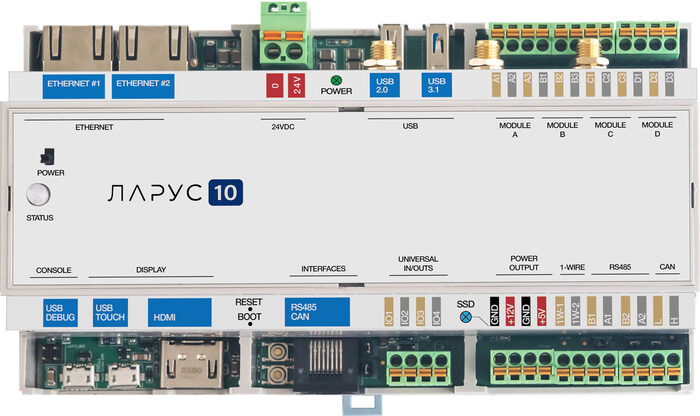
Mental Model
"How to reliably deliver data to the platform — and process it right here if needed"
Larus solves three tasks:
- Collection — polls Passers via Modbus RTU
- Buffering — stores data locally when connection is lost (store-and-forward)
- Transmission — sends data to Strix via MQTT, OPC UA, or REST
Model Comparison
| Parameter | Larus-10 | Larus-100 |
|---|---|---|
| Primary purpose | IIoT gateway | Industrial PLC + gateway |
| Programming environment | Web interface (no 4diac) | 4diac IDE (IEC 61499) |
| I/O modules | No | AI8, AO8, DI16, DO16 |
| Modbus RTU (Passers) | ✅ Master | ✅ Master |
| Modbus TCP | ✅ | ✅ |
| MQTT | ✅ | ✅ |
| OPC UA | ✅ Client | ✅ Server + Client |
| CAN | ✅ (1 × terminals) | ✅ |
| IEC 61499 (Forte) | ❌ | ✅ |
| Local logic | Minimal (filters, aggregation) | Full (PID, sequencers, algorithms) |
| Target application | Monitoring → Strix | APCS, Siemens/ABB PLC replacement |
Protocols
Larus supports all common industrial protocols:
Downstream (to devices):          Upstream (to systems):
  Modbus RTU (Passers)      ──►   MQTT (Strix, AWS IoT, Azure IoT Hub)
  Modbus TCP                ──►   OPC UA (SCADA, MES)
  CAN (Larus-100)           ──►   REST/HTTP (web services)
When to Use Each Model?
Choose Larus-10 if:
- You need monitoring without local control logic
- You want a quick start (web configuration in 30 minutes)
- Budget is limited
Choose Larus-100 if:
- You need local logic (PID, sequencer, emergency protection)
- You are replacing an existing PLC (Siemens S7, Allen-Bradley, Schneider Modicon)
- You need analog/digital I/O
- Autonomous operation is required (without Strix connection)
Next
- Larus-10: IIoT Gateway — configuration, wiring diagrams
- Larus-100: Industrial Controller — 4diac, I/O, programming
- Use Cases — ready-made solutions and reference projects